
Prince Among Slaves
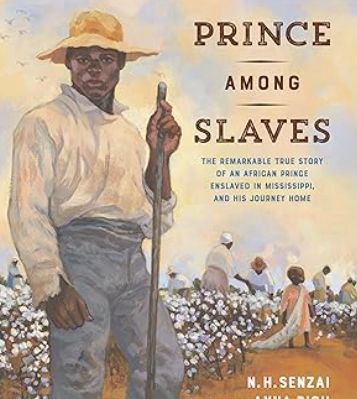 Prince Among Slaves
Nonfiction / Biography / Upper Elementary
Penguin Group
January 14, 2025
49 pp.

"The extraordinary and consequential biography of Abdulrahman Ibrahim Ibn Sori, a Muslim West African prince turned enslaved plantation worker, and his lifelong fight to be free and return home. In 1762, Prince Abdulrahman Sori was born in West Africa’s prosperous kingdom of Futa Jallon. His name meant “servant of God,” and as a child, he was fascinated by the stories of the great prophets Moses, Jesus, and Muhammad. Each had faced great challenges, and each had accepted their fate as determined by God, no matter how difficult. Always curious, Abdulrahman grew up to become a scholar, fluent in five languages. He was also a warrior, a husband, a father, and an instrumental leader in his father’s court. But that happy life was cruelly ripped away the day Abdulrahman and his men were ambushed while on patrol by a rival [group] and sold to English traders. Forced aboard a ship, Abdulrahman was taken across the Atlantic to Natchez, Mississippi, and enslaved. Resistant at first, Abdulrahman ran away, but ultimately, like the prophets he revered, Abdulrahman accepted his fate as determined by God. So with a heavy heart, he began a new life helping the plantation owner prosper, and after some time, though risky, Abdulrahman found love and became a father again. Then, by virtue of an incredible coincidence, Abdulrahman’s life changed once more, setting into motion a series of events that would not only free Abdulrahman, but return him to African shores after forty years of enslavement. Incredibly well-researched, N. H. Senzai chronicles Prince Abdulrahman’s remarkable life and journey to freedom with extraordinary grace and care, illuminating not only the horrors of slavery, but how one Muslim man relied on his faith in God to persevere. Anna Rich’s striking art makes each scene of Abdulrahman’s life sing with emotion and meaning." Publisher
Prince Among Slaves brings the rich and fascinating story of an individual West African Muslim enslaved in Mississippi around the turn of the 19th century to a children’s audience with vibrant illustrations. As such, it adds an important element to our understanding of the Trans-Atlantic slave trade and the little-known experiences of African Muslims enslaved in the United States.
Author Naheed Hasnat Senzai adapts a biography and film on Abdul Rahman Ibrahima ibn Sori for a children’s audience. Born in 1762 to a Fulani ruler of Timbo (in modern-day Guinea), the young man was captured during a raid against a rival group, then sold into the Transatlantic slave trade. Although he attempted to escape, he lived most of his life enslaved in Mississippi before obtaining his freedom and traveling to Liberia through a series of a turn of events. Based on historical research, the book presents the full life personal journey of an enslaved African around the turn of the 19th century, including beginnings in West Africa, the harrowing middle passage to the Americas, coping with enslavement in Mississippi, creating a family, and seeking freedom. Relatively few of these histories were recorded. Senzai and illustrator Anna Rich gift children insight into a difficult-to-obtain past through this book. The author’s note on the back page offers helpful further information about this history and the research behind it.
The book strikes an appropriate balance of providing specific information with a clear narrative, enhanced by colorful and elucidatory illustrations. The text and the illustrations work together to advance the story. Each plays its part. The text provides important historical information and yet the illustrations are not burdened by too much text. For example, descriptions of what Abdul Rahman Ibrahima’s childhood may have been like in the Fouta Djallon region of West Africa are accompanied by scenes of children playing outside and learning near a busy part of the city. When Abdul Rahman Ibrahima is sent to study in Timbuktu, a two-page spread depicts multiple scholars praying in a grand mosque. We are given scenes of the prince’s activities as a warrior and prince upon his return to Timbo, developing his character and the story.
Although the narrative is pitched toward a younger audience, the book does not sacrifice complexity and the pain of the experiences for simplicity. This can help children understand more accurately the dynamics of this difficult history. We see both Africans as well as Europeans and European Americans as protagonists and antagonists. Another strength of the book is the way Senzai imagines Abdul Rahman Ibrahima’s thoughts and emotions at different points in his journey. This helps the reader identify with his experiences and understand the choices he made. Abdul Rahman Ibrahima’s commitment to practicing his faith and to his wife, Isabella, and their children are prominent themes that also humanize the main characters. Readers can learn about the Trans-Atlantic slave trade, related national and international politics, and the full lives of enslaved people all at the same time.
In short, the story of Abdul Rahman Ibrahima is truly remarkable and Senzai and Rich succeed in bringing it to light in a powerful way for a younger audience.
Leslie Anne Hadfield, PhD
Brigham Young University
Published in Africa Access Review (November 10, 2025)
Copyright 2025 Africa Access