
Yeseni and the Daughter of Peace
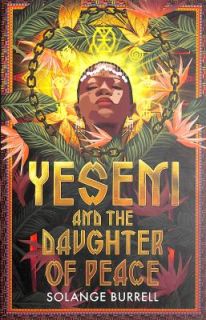 Yeseni and the Daughter of Peace
Historical fiction / Ghana / Ages 14-18
Unbound
2025

"The year is 1748. Elewa, known as 'the Daughter of Peace,' bears a heavy responsibility on her young shoulders: to maintain the fragile truce between the warring peoples of her West African kingdom. But as she begins to understand her role in the peace negotiations, even greater pressures emerge. Elewa discovers that she has Yeseni, a powerful gift that allows her to see events from any point in time, and to travel into the past and future. When she experiences horrific visions of life aboard a slave ship, she realizes she has to face the ultimate crossroads. She could use her gift to intervene in the past and try to prevent the transatlantic slave trade ever taking place. But that means she, as the Daughter of Peace, would be leaving her village behind at a precarious moment in the reconciliation process. Whichever path she chooses to take, the future of her people lies on her shoulders"--Provided by publisher.
Yeseni and the Daughter of Peace tells the story of colonial Ghana . . . that is not colonial Ghana. Elewa grows up in during a war between the Okena and Oleba. She begins to see visions, which include those of slavery and conflict. Much like Jonas in The Giver or Nisha in The Night Diary, she becomes the person in her family and community who can see.
Solange Burrell, a Briton of Ghanaian descent, has worked primarily as a journalist, with Yeseni being her first book. It is in many ways a sweeping epic in the style of Yaa Gyasi. But unlike Gyasi’s work, Yeseni stays within its generation. Particularly for readers new to Africa, it provides an interesting juxtaposition of real and fictional. The story begins in “West Africa,” although context clues will point toward its setting as the Gold Coast. Character names such as Kumasi or Kofi sound very Ghanaian. Characters discuss religion related to Allah. And yet, names of kingdoms and societies remain fictionalized. I thought this was a very interesting choice. It grounds the work in ways that will be familiar to adults reading the material with some historical knowledge. But it provides space for children or those less familiar with African History to do background reading and glean factual information. I could see assigning this to a class of middle or certainly high school students and asking them to pick out what details match which societies, then doing some comparative work on them.
Myra Ann Houser, Ph.D.
Ouachita Baptist University
Published in Africa Access Review (October 27, 2025)
Copyright 2025 Africa Access