
Soni and the Life Drinkers
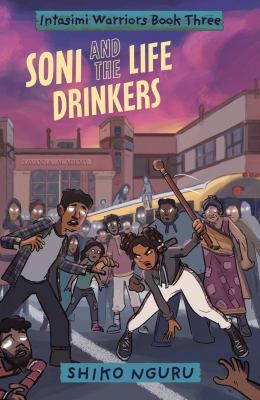 Soni and the Life Drinkers
Fiction / Kenya / Ages 9-11
Lantana Publishing
May 6, 2025
204 pp

"The Intasimi Warriors are about to embark on their third and most challenging adventure to date—saving their beloved mentor from dying at the hands of the Life Drinkers. When Soni discovers that her mom has a twin sister with a dark secret, she just might have found the key to discovering the Life Drinkers' identity. As she delves deeper into Nairobi's dark underbelly, Soni must learn to see the world for what it is—with all its beauty and ugliness. What price will she have to pay to stop the Life Drinkers from draining Mr. Lemayian's life, and will saving his life come at the expense of her own A heart-stopping, thrill-a-minute journey into the heart of an alternative Kenya where monsters roam the streets and one brave 12-year-old, with the help of her closest friends, will learn a lesson in self-sacrifice that she will never forget." Publisher
Fast-paced and suspenseful, this third installment of the popular Intasimi Warriors series by well-known Kenyan author Shiko Nguru extends the adventures of the spunky and intrepid 12-year old heroine Soni and her entourage of loyal friends. Young readers will be mesmerized by the determination of Soni and her three friends to combat evil forces with the help of their individual superpowers and their personal charms (Entasim). The plot certainly will be familiar to young audiences schooled in the famous adventures of Harry Potter and the equally popular Binti series by Nnedi Okorafor.
The Intasimi Warrior series gives these speculative narratives a captivating local flavor, from the name Intasimi, which means “magical charm” in the Maa language, to the local foods and fabrics, the Matatus and boda bodas cruising through the urban environment of Nairobi that delivers the setting for the series, the stylish “bantu knots” gracing Soni’s hair and the lively dialogue peppered with Swahili greetings. The novel also acknowledges the socio-economic differences shaping this diverse urban locale when Soni and her friends, who enjoy the comforts and resources of a middle-class life, visit a densely populated city neighborhood where residents have to contend with inadequate sanitation, while still claiming it as their home and turning it into a welcoming place for the communal meal concluding the novel.
With its frequent reliance on character focalization, the novel affords the reader intimate access to Soni’s thoughts, joys, and worries; to a heroine still working out the complexities of human life, of who to trust and who to guard against, of reconciling naïve aspirations with her steadily increasing superpowers, of respecting her parents’ authority while carving out her own autonomy. These struggles will be familiar to a young readership, even if they lack the magical capabilities gifted to Soni and her friends. Among them is Mwikali, whose visionary power fuels her intuition and creativity; Xirsi, who summons animals to the Warriors’ defense and whose endless curiosity explains his research skills; and Odwar, whose physical strength is finely calibrated to protect the friends in their endeavors. And finally, there is Soni, who channels the rhythm of her own body into sonic waves “powerful enough to blast anyone and anything clear across the room” (13). While these gifts might be magical, the powers they confer are within the reach of young adult readers encouraged to claim their intuition, their strength, their curiosity, and their creativity. It also helps that Soni channels her fantastical powers into an energetic and fun dance in the novel’s opening chapter.
The plot revolves around a familiar narrative trajectory when the Warriors confront an evil-minded group ominously called “The Takers,” who—true to their name—target the group’s trusted mentor Mr. Lemayian, and eventually also Soni, by threatening to suck the life out of them, taking their life time, not unlike the dementors in the Harry Potter series. Along the way, Soni will learn important life lessons about how to invest individual powers for the collective good, about negotiating a healthy compromise between ambition and the desire to always want to be the best, about trust and grief, and about the shades of grey that muddy the difference between good and evil. This lesson is imparted to Soni as family secrets and conflicts are slowly revealed to her, and as she learns to trust her cousin Thandiwe, a hybrid life form, part monster, part human, and the child of Soni’s long lost aunt, who has embraced the dark side of magic and usurped the powers not naturally gifted to her. As a self-declared “hybrid,” Thandiwe straddles the world of good and evil, breaking with her immediate family when choosing to assist the Warriors in their battle against The Takers. Sharing the novel’s central message with Soni (“It’s like I told you, not everything is black and white. Tough people get knocked down sometimes. That doesn’t make them weak. Good people make poor decisions. That doesn’t make them bad.” p.158), Thandiwe verbalizes what is echoed throughout the novel when Soni realizes the similarities between her and her “evil” aunt, when the underresourced neighborhood becomes the locale for a festive meal, and when evil monsters exercise autonomy from the group’s “hive mentality” and decide to support humans. Ambiguity thus unsettles the novel’s chapter headings, often presented as binaries, and instead supports the persistent narrative motive of twinning, from Soni’s mother and her twin sister to Soni’s magical charm of two identical bracelets.
Skillful in its exercise of the young adult fantasy genre, the novel ends each chapter on a cliffhanger, propelling the narrative forward as the Warriors’ battle with The Takers gains momentum, giving Soni an opportunity to prove her maturity and transform into a full-fledged warrior, ready for the final battle between humans and monsters that will surely be recounted in future installments of the series. That Sonic and the Life Drinkers associates these adversarial forces with a specific Kenyan ethnic minority remains problematic, however. Even though the cursory references to the skin color and ethnic identity of the family leading The Takers might be missed by some young readers, and even as this representational choice is potentially counterbalanced by the novel’s insistence on the affinity of good and evil, it still remains a baffling authorial decision given the historical tensions between ethnic groups in Kenya. It is also at odds with the novel’s commitment to cross-ethnic alliances when juxtaposing references to Maasai and Gikuyu cultures and when bestowing Gikuyu, Somali, Luo and even South African names onto the Intasimi Warriors and their allies. One hopes that this multiethnic allyship is extended in future installments of the series to appeal to all brown and black Kenyan readers as well as to the novels’ diverse readership across the globe.
Marie Kruger, Ph.D.
University of Iowa, Department of English
Published in Africa Access Review (February 25, 2026)
Copyright 2026 Africa Access