
Oshún and Me: A Story of Love and Braids
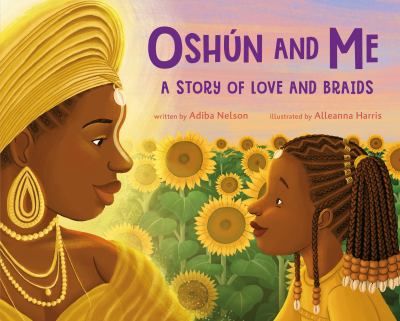 Oshún and Me: A Story of Love and Braids
Picture Book / Nigeria / Ages K-3 / Orisha
Feiwel & Friends
January 14, 2025

"In this warm, joyful debut picture book, a little girl learns about her Afro Latin heritage as her mom braids her hair with cowrie shells." Publisher
Adiba Nelson’s Oshún and Me: A Story of Love and Braids is a beautifully illustrated children’s book that celebrates family and cultural heritage through the art of braiding. It centers on Yadira, a preteen girl of Afro Latin heritage who is about to start at a new school. On the eve of her first day of school, young Yadira sits in her family’s sundrenched kitchen waiting for her mother to braid her hair, a Sunday ritual. As her mother weavescowrie shells into Yadira’s braids, she shares the history and significance of this tradition. Yadira learns that the cowrie shells signify that she can count on the protection of Oshún, the goddess of love and beauty. The tender ritual between mother and daughter becomes a powerful lesson in cultural heritage, arming Yadira with the pride and self-esteem she needs to enter her new classroom.
Over the course of the story, the illustrations by Alleanna Harris establish a connection between Yadira’s home (somewhere in the US) and an ancestral land, Nigeria, home of Oshún (though the narrative makes no mention of a specific geographical location). The narrative moves back and forth between Yadira’s relationship to her mother and her relationship to Oshún, who is conceptualized as motherly. The parallel relationships are effectively brought to life in the images and the text. Rather than representing the homeland in a stereotyped fashion, the book portrays Nigeria as a dense, thriving landscape of sunflowers (an accurate picture since Nigeria grows sunflowers as a commercial oilseed crop). Sunflowers also happen to be Oshún’s favorite flower.
Oshún’s association with gold, yellow, and beauty (and shiny things) is also well illustrated in the various scenes where the Orisha appears. Children will understand that with Oshún’s support, Yadira has nothing to fear in life. As a girl with a disability (signified visually by the wheelchair she sits in), Yadira anxiously anticipates her first day at her new school. Thanks to the cowrie shells braided into her hair, she feels the loving connection to Oshún and her fear dissipates. On the playground, Yadira meets other children. Supported by a rolling walker, Yadira “runs” toward the swing. Once she launches her swing in the air, she experiences a thrilling connection to the other children who, she realizes, all wear braids. The more subtle message conveyed by the image of happy children swinging together is that, in the air, Yadira’s disability disappears. She belongs in the sense that she no longer feels different from the other children. This, the audience comes to understand, demonstrates the loving power of Oshún (who stands inconspicuously behind the children playing together).
The book does a great job of weaving African (and Latin) heritage into the everyday life of a young Black girl who worries about fitting in at school, while also enjoying the beauty of her braids and what they signify. Meanwhile, we also understand how her mother, her fingers practiced and gentle, weaves the connection between Yadira and her African ancestors as she braids cowrie shells and gold clips into her daughter’s hair.
Oshún and Me tells a compelling story that will appeal to young girls of Afro Latin heritage. The book highlights the importance of family, spirituality, and heritage while staying focused on the ordinary preoccupations (fashion, appearance, school life, and friendship) of a preteen girl growing up in the US. The book successfully draws on ordinary things (braids, cowrie shells, etc.) to evoke abstract issues (religion, heritage, people’s relations to the orisha). In fact, the book’s greatest strength is precisely how it uses sensory experience—the sweet smell of braiding pomade, the braid’s stunning zigzag patterns on Yadira’s scalp, the tight tug on her roots, and the click-clack of the cowrie shells banging against one another—to translate something profound about the power of intergenerational bonds, the place of cultural heritage in a girl’s life, and the connection between identity and aesthetics.
In sum, by narrating how a styling session between a mother and a daughter turned into a celebration of ancestral connections, Oshún and Me effectively helps Black girls navigate their place in history during a particularly turbulent time. The one issue the book fails to address satisfactorily is Yadira’s disability. At the beginning of the story, Yadira sits in a wheelchair. The next day, on her way to school, she uses a walker. Did Oshún intervene? Does the transition between wheelchair and walker speak to a transformation in Yadira’s self-esteem? This is the part that is left to our imagination—perhaps too much so.
Adeline Masquelier, PhD
Tulane University
Published in Africa Access Review (April 8, 2026)
Copyright 2026 Africa Access