
Kwesi and Nana Ruby Learn to Swim
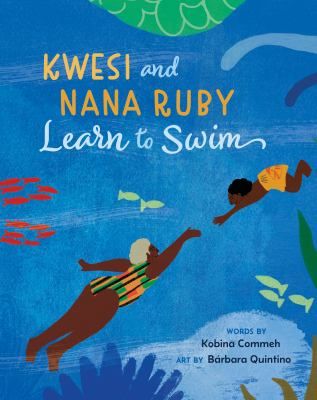 Kwesi and Nana Ruby Learn to Swim
Picture Book / Ghana / Ages 4-8 /
Barefoot Books
February 4, 2025

Kwesi is afraid of the water. When Nana Ruby confides that she is also afraid of swimming, they turn to the West African legend of Mami Wata to face their fear.
There are storytellers, and then there are STORYTELLERS. Let me tell you, Kobina Commeh is the latter. I have been trying to figure out how to explain what makes Kwesi and Nana Ruby Learn to Swim, his debut picture book, so special. On the surface, it is a story about swimming. But in Commeh’s hands, swimming becomes a portal into conversations about history, fear, memory, Ghanaian culture, African cosmology, intergenerational storytelling, and the power of imagination. And somehow, he manages to do all of this without making the book feel like a history lesson. That, to me, is the mark of a storyteller who knows exactly what he is doing.
The story follows Kwesi, a young boy who struggles to learn how to swim and feels increasingly embarrassed that he cannot keep up with his friends at the pool. His friends tease him about his inability to stay afloat and participate in their pool games, leaving Kwesi frustrated, sad, and discouraged. When he confides in his grandmother, Nana Ruby, he discovers that she has never learned to swim either. Rather than dismissing his fear, Nana Ruby shares her own experiences and helps Kwesi understand that his anxiety is not just a personal failing. She introduces him to the history behind Black people’s complicated relationship with swimming and, eventually, to an unexpected figure who might help them both.
By the end of the story, Kwesi not only becomes a confident swimmer but is able to teach Nana Ruby a few tricks of his own. The reversal is particularly lovely because the story becomes about more than a child overcoming a fear. It is also about knowledge moving between generations. Nana Ruby gives Kwesi history, stories, and encouragement. Kwesi, in turn, gives Nana Ruby something new. Learning becomes reciprocal. Old people can teach young people and vice versa.
One of the things Commeh does exceptionally well is to bring African American history into conversation with Ghanaian and African speculative traditions. Nana Ruby explains to Kwesi that his fear of swimming has a history. She tells him about the segregation of swimming pools and other public spaces under Jim Crow, when Black Americans were legally and socially excluded from many facilities that were available to white Americans. This history helps Kwesi understand that the discomfort surrounding swimming did not emerge from nowhere. Commeh adroitly translates this complicated history into language that young readers can understand. He does not overwhelm Kwesi, or the reader, with the brutality of Jim Crow, but neither does he erase the history. Instead, he gives children an accessible entry point into understanding how racism can shape everyday experiences across generations. Kwesi’s fear becomes connected to something much larger than himself: memory, history, and the ways that experiences can be passed down.
And then Commeh does something I absolutely love by taking on the African speculative pantheon! He brings Mami Wata into the story. Mami Wata is a powerful figure across various African and African diasporic traditions. She is a merbeing often associated with beauty, wealth, danger, healing, and spiritual power. In many contemporary retellings, however, Mami Wata is often presented primarily through narratives of danger, particularly stories about luring people to the sea in order to drown them. Commeh offers us a different possibility. Here, Mami Wata is not a figure to fear. She is a figure Kwesi can call upon for help. This reversal is significant because when Kwesi invokes Mami Wata, she appears not as a frightening supernatural being but as a reassuring presence who offers guidance and even a soothing song. The story thus transforms the relationship between the child, the water, and the spirit figure. What was once a source of fear becomes a space of possibility. There is also much to be said about invoking Mami Wata from Ghana to the US to help deal with anxieties towards swimming because that fear is minimal in Ghana. There are children as young as three years old who surf the waves in the coastal communities in Ghana. Let me not break into a different tangent here, but please look up the history of surfing along the Gold Coast (former name of Ghana).
Barbara Quintino’s illustrations make this transformation of Mami Wata even more powerful. Her depiction of Mami Wata is striking: she is beautiful, regal, and unmistakably connected to African visual traditions, with locs, cowries, and other details that root her in a distinctly African aesthetic. There is something wonderful about seeing an African water spirit presented not as a monstrous or frightening figure but as a source of beauty, knowledge, wealth, and assistance.
This representation matters especially for young Black readers. So much of the work of children’s literature involves deciding what kinds of worlds children are permitted to imagine themselves inhabiting. When children encounter African cosmological figures as sources of wonder rather than superstition or something to be feared, the possibilities of that imagination expand. Mami Wata is not simply a character in this book. She becomes part of the imaginative vocabulary available to its young readers. Moreover, it is important to show younger Black audiences that there are indeed African mermaids who exist! This is necessary to expand not just their imagination but also heighten their pride in African cosmology.
And Commeh does not stop there. The book is filled with Ghanaian cultural references that make the story feel wonderfully familiar. Adinkra symbols appear throughout the illustrations, bringing Ghanaian visual culture into the world of the story. Adinkra symbols carry proverbial meanings and have historically been used to communicate ideas, values, and philosophical concepts. Their presence adds another layer to the book, inviting children to encounter Ghanaian cultural knowledge as something beautiful, meaningful, and worthy of attention.
Then there is the food! Commeh includes Ghanaian staples such as fufu and groundnut soup, which, frankly, and you can quote me, should have more clout than jollof!
He also introduces readers to oware, the Ghanaian strategy game played with seeds or counters in a board containing small pits. It is a game of counting, anticipation, and strategy, and its inclusion is another wonderful reminder that Ghanaian culture is not simply something to be displayed in the background. It is embedded in the everyday life of the characters.
These details are what make Kwesi and Nana Ruby Learn to Swim feel so rich. Commeh understands that cultural representation does not have to announce itself with a giant sign. Sometimes it is a bowl of fufu and groundnut soup. Sometimes it is an Adinkra symbol tucked into an illustration. Sometimes it is a grandmother telling her grandson a story. Sometimes it is a game of oware. And sometimes, wonderfully, it is an African water goddess showing up to teach a little boy how to swim.
What I find most impressive is how all of these elements work together. History is not separated from fantasy. Ghanaian culture is not separated from African American history. The grandmother’s memories are not separated from the child’s imagination. Instead, the book creates a world where these things can exist together.
And perhaps that is why I keep coming back to the idea of Commeh as a STORYTELLER. He understands that children’s stories can hold many things at once. A picture book can make you laugh, teach you history, introduce you to a game, make you hungry for fufu, introduce you to Mami Wata, and give a child a new way to understand fear. None of these things cancel the other out.
For a debut, Kwesi and Nana Ruby Learn to Swim is remarkably ambitious, but it never feels like it is trying too hard. It is warm, imaginative, culturally grounded, and genuinely fun. Commeh and Quintino have created a story that gives children history without taking away their sense of wonder and gives them fantasy without disconnecting it from cultural memory.
I cannot recommend this book enough. It is a beautiful work of art, and I am genuinely excited to see where Kobina Commeh takes his storytelling next. If this is what his debut looks like, I am very curious about the worlds he is going to build next. Five solid stars.
Elizabeth Abena Osei, MA
University of Maryland, College Park
Published in Africa Access Review (October 20, 2026 )
Copyright 2026 Africa Access