What happened on Thursday
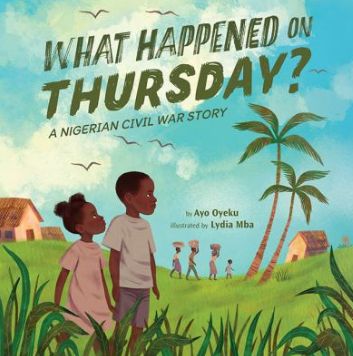 What Happened on Thursday?
Picture Book / Nigeria / Ages 8-10
Amazon Crossing Kids
September 17, 2024
Unpaged

"A powerful story of family love amid the backdrop of war, as seen through the eyes of a child. The Nigerian Civil War began and ended on a Thursday, and for the family in this book, their lives are forever changed by that day. Told from a child's perspective, this story follows one family on their journey as they lose their home, traverse a country under the siege of war, and finally settle in a camp for displaced persons." Publisher
What Happened on Thursday?” by Oyeku and Mba is a descriptive book about the Nigerian Civil War, told through the eyes of a child. The book focuses on an unnamed family of four who are caught up in the maze of the terrifying war that began on a Thursday in 1967. Each page presents the war from the perspective of one of the children as they struggle to make sense of the adult world that the war has thrust upon them. The story follows the kids and their parents as they process these events from the breakfast table to their school, from the absence of quiet to the first forceful evacuation of their home, from the long drives to safety, to the long walks to an internally displaced people’s camp, and the hunger and starvation. The kids are unaware of the cause of these events, even discomfited by them, but also unbroken. The book shows how suddenly these kids move from worrying about their homework and school tasks to listening to the radio for information about what was happening in the country.
Several books have been written about the Nigerian Civil War for adult readers, with each book arguing a case for the innocent and the guilty, but What Happened on Thursday? takes a different approach and appeals to a different reader. The book attempts to centre the events of the brutal war on the family and the effects the war had on them, particularly the children. Given that it was written for children to account for the dark years of Nigeria’s history, the narrative accomplishes this task successfully, merging illustrations that capture the depth of destruction and desolation from the war with the simple, clear, and straightforward story. The book confronts the general events of the war rather than its specific history. This allows for the presentation of the war as a family’s attempt to navigate the series of shocks from the experience and the triumph of the human spirit, rather than the portrayal of the casualties that is often associated with war. In other words, the purpose is not to shock the reader. Similarly, the characters are unnamed, thereby blurring the ethnic identities of the children and, by extension, the politics of the war. It speaks to the innocence of children in war and how they lack the agency to pick sides but are rather thrown into the fray headfirst as victims.
If What Happened on Thursday? succeeds in its task of presenting a complex subject to kids, it is due to its skilful manipulation of the affordances of words and illustration. The visual grammar carries much of the burden of narrating what cannot be said in words, thereby enabling young readers to understand what is happening in the background of this alphabetical coyness. The story presents a visual intimacy of family life, as the children and their parents sit down to breakfast at the beginning of the book, which is sharply contrasted by images of explosions and panic later in the story. It also shows the numerous people displaced as a result of the war and their desperate hope for food and medicines while in the displaced people’s camp.
The loss of familial bliss is explained through subtle hints, such as the absence of food, a house, and a car – objects that contributed to the calm and serenity of their middle-class life, now suddenly ripped away. The illustrations are appropriately tempered. There are no gory details or references to bloodshed or death that can be horrifying or heavy for children. The illustrations depict the fires and explosions from a distance, situating the atmosphere of war.
The book ends on a note of peace and the return to the calm that the kids once knew. The family can now sit beneath a tree and contemplate the stars and moon in the sky, rather than the explosions that drove them away not too long ago.
Harrison Mmerenu, PH. D Candidate
Texas Tech University
Published in Africa Access Review (November 18, 2025)
Copyright 2025 Africa Access