
Ruth First Never Backed Down
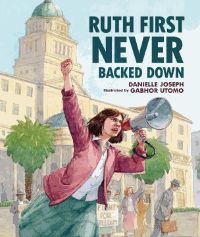 Ruth First Never Backed Down
Anti-apartheid activists
Kar-Ben Publishing
2023

"Ruth First was born in South Africa, where her Jewish family fled from the danger in Europe during WWII. Committed to speaking out against apartheid, she did so all her life, never backing down"--
Ruth First Never Backed Down is an inspirational picture book about the well-known South African political activist whose determined opposition to the apartheid regime led to her untimely death in 1982 when she was assassinated by a letter bomb while living in exile in Mozambique. Written by Danielle Joseph, an author of several young adult novels and picture books, who relocated from her native South Africa to the United States, the publication offers a welcome addition to the undertold history of women’s contributions to the dismantling of the apartheid state. The author’s investment in Ruth First’s story is poignantly illustrated by her decision to deviate from the rhetorical convention troubling many biographies of female historical figures and exclude from the narrative First’s husband, Joe Slovo, himself a renown political dissident. Unnamed, he only appears as a bespectacled shadow in several illustrations while the book focuses exclusively on Ruth First’s allegiance to her political cause. If First is committed to the pursuit of racial equality, then the book is equally devoted to honoring her legacy.
Following Ruth First’s biography from her early childhood through her teenage years, her work as an investigative journalist in South Africa to her imprisonment and exile in Great Britain and Mozambique, the book roots her activism in her parents’ belief that it is necessary to “[speak out] against anti-black racism,” a belief partly motivated by their Jewish heritage and the refuge their own parents, Ruth’s grandparents, found in South African when escaping from “the dangers and injustices in Eastern Europe.” The intergenerational experience of persecution and the decision to oppose state-sponsored violence serve as the background of Ruth’s steadily developing political activism, from her teenage self starting a club to “discuss books about inequality” to her increasingly public work as a student activist, and her role as an investigative reporter exposing the economic exploitation of black mineworkers. Driven by a profound sense of social justice, First’s commitment to dismantling the apartheid regime is portrayed as unwavering, even as she is confronted with the hostile interventions of the authoritarian state, banned and prohibited from working as a journalist, arrested and detained in solitary confinement, and eventually forced into exile.
Ruth First’s firm commitment to exposing racialized violence is intended (and succeeds) as an inspiring narrative for young audiences still unaware of the meaning of apartheid and the extent to which a racially segregated state violated even the most basic of human rights. Illustrated by Gabhor Utomo, the age appropriate drawings ease young readers into these challenging historical circumstances. The drawing of a very young Ruth, for example, standing at the living room door to eavesdrop on her parents’ conversation about the political situation, serves as an easily understandable reminder of how children absorb information in domestic settings, even as caretakers try to shield them from distressing information. Another panel depicts a black child looking at a white boy of approximately the same age, who sits on a park bench designated for “whites only.” Though the children are placed in close physical proximity, the signage illustrates their separation in a society that assigns privileges solely on the basis of race. Given the young readership, the book opts to portray traumatic situations with considerable restraint: Ruth First’s detention reflects the harshness of the prison conditions without overwhelming young readers with graphic details, and the letter bomb that takes her life is only depicted as scattered debris on her writing desk, removing Ruth First from the scene of violence. Wisely, the book leaves it to parents and caretakers to guide young readers through these distressing events.
Despite its inspirational and educational potential for teaching young readers about resistance to apartheid, the value of the book is limited by its choice to frame Ruth First’s story with recurrent references to “Mother Africa,” a hospitable and mythological presence that “loves all her children,” that inspires Ruth “to use her voice to fight this injustice,” that “picks her up” in times of distress and that, eventually, folds her back into “Mother Africa’s tapestry.” Intended as a rhetorical device to reassure young audiences of the moral legitimacy of First’s political beliefs, this gendered troping of the continent is at odds with the social realism otherwise informing the narrative. The mystical “Mother Africa” here serves as a substitute for the relationships and circumstances that would have comforted, inspired and sustained the real Ruth First. Rather than being supported by other women activists while in detention, whose names are etched into the floorboards of her prison cell, the narrative insists on the intervention of Mother Africa who “picked her up and said, Use your voice to keep on fighting.” Rooting political activism in a mysterious spiritual force ultimately does not benefit children as they try to understand the complexity of the anti-apartheid struggle and the need for collective action and mutual support when confronting state-sanctioned violence. Perhaps most problematic is the book’s opening reference to “Mother Africa [welcoming] immigrants fleeing violence” when some of these immigrants are responsible for the apartheid system that motivated Ruth First’s political activism and that explains her death in Mozambique. The book’s aim would have been better served by trusting in the ability of young readers to absorb layered historical narratives and to understand that even a heroine who “never backs down” needs support from those who share her political beliefs.
Marie Kruger, Ph.D.,
University of Iowa, Department of English
Published in Africa Access Review (December 1, 2025)
Copyright 2025 Africa Access