Nearer My Freedom : The Interesting Life of Olaudah Equiano by Himself
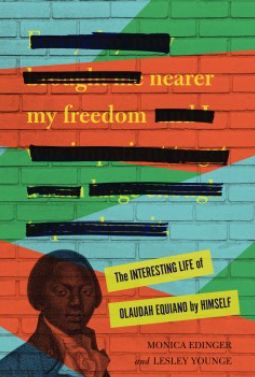 Nearer My Freedom : The Interesting Life of Olaudah Equiano by Himself
Young Adult Nonfiction / Ages 12-18 / Autobiography
Zest Books (Tm)
2023

"Using Olaudah Equiano's autobiography as the source, the text shares Equiano's life story in found verse. Readers will follow his story from his childhood in Africa, enslavement at a young age, liberation, and life as a free man"--
Monica Edigner and Lesley Younge have taken a well-known text, The Interesting Narrative of the Life of Olaudah Equiano, or Gustavus Vassa, the African, and produced something fresh and surprising. The authors are veteran classroom teachers and what immediately stands out about this version of the well-known story is that it is intended to be used in a classroom. To that end, Nearer My Freedom will serve anyone who needs an introduction to the life of Olaudah Equiano, the Igbo man who was born free in Nigeria and following his capture and sale as a child-slave traveled around the Atlantic serving in a variety of jobs and locales until he managed enough education and savings to earn his freedom. Equiano’s story, in his own words, is a tale about choices and consequences and, he hoped, a call to the abolitionists of his day. But Equiano’s words, his grammar and syntax, are unapproachably difficult for many students today. The text is certainly too long to be used in the vast majority of middle or high school classrooms. Nearer My Freedom presents Equiano’s text in a way that is digestible for today’s students while maintaining fidelity to the emotional content of the narrative that was always meant to elicit action from the reader.
Edinger and Younge’s strategy is to present Equiano’s words in a format that is more familiar to modern readers by reorganizing Equiano’s text into verse. The original text is shortened, excised, and sometimes rearranged. Given the popularity and wide-classroom use of verse books like Elizabeth Acevedo’s The Poet X or Kwame Alexander’s The Crossover, Edinger and Younge’s adaptation of Equiano’s story into verse is a clever strategy that may entice students already familiar with and interested in verse to approach a text they might not otherwise read. What remains, in the hands of these skillful editors, is the poetry, the almost raw emotion, that provided the heartbeat and drama for Equiano’s original story. Even though I am familiar with Equiano’s story, I found myself not wanting to put Nearer My Freedom down.
Edinger and Younge make two additional smart moves in the presentation of this text to bring Equiano’s world to life for the reader. First, they provide short contextual essays frequently throughout the text as opposed to adding long footnotes or placing this information at the back of the book. Young readers will find the information they need to understand the text they are reading close in proximity to the actual text. Not only do these contextual asides provide information on geography (“The Mosquito Coast”), important people (“Granville Sharp”), or themes (“Christianity and Slavery”) but because they occur so frequently in the text the contextual material further breaks down the text into digestible units. Teachers call this ‘chunking’ and the effect in Nearer My Freedom is important. By chunking the verse they created, the authors allow the reader’s mind time to process the emotion evoked in the poetry. The second strategy the authors use in terms of presentation is to discuss their method in the end material. In a brief section called “Creating a Verse Version” the authors show how they took the original text and made a blackout poem with it. This demonstration of their method allows the reader to see the editorial choices they made about which words, ideas, and emotions remained from the original text.
Nearer My Freedom is the rare book that I cannot wait to use in my high school history classes. The text is engaging, the book is richly illustrated and well researched, and the authors pull back the curtain so students can see the process of how experts can engage with complicated historical texts. But, what makes it so valuable in the classroom is also that the book evokes more questions than it answers. The full title of the book is Nearer My Freedom: The Interesting Life of Olaudah Equiano by Himself but these are not his words, certainly not his words ‘by himself’. Though they used his prose to make theirs, the authors have edited and rearranged the text. Is this still Equiano? The move to verse is interesting and useful for evoking emotion, but emotion wasn’t Equiano’s only motive for writing the text. What does verse hide that prose can elucidate? Perhaps most importantly, what was cut and lost in the process of making this text? Edinger and Younge – two veteran teachers – have crafted something here that is surprising and challenging and, above all, useful. Nearer My Freedom deserves to be read, discussed, and taught. It will certainly be used to introduce new generations to Olaudah Equiano and, with any luck, it might inspire some of them to seek out his original text.
Reviewed by Jared Staller, Ph. D., St. Francis Episcopal School
Published in Africa Access Review (April 4, 2024)
Copyright 2024 Africa Access
Our Autistic Support Class did a Read Aloud with their teacher to discover how Equino had lived with his family and then was kidnapped with his sister. We discovered what a remarkable life this man led and how he affected change.
I love that this book is accessible to students in all levels!
I teach AP World History. I appreciate the account because I am always trying to tie nonfiction text to the content. We read Ch.1 12-17, Equiano’s experience on the Middle Passage as well as a few short excerpts from Europeans on the Middle Passage. The class then had a discussion on the reliability/trustworthiness of the documents. At first, all the texts are deemed reliable. I then tell students that there is some question about Equiano’s country of origin (pp.18-19). Many students concluded that Equiano’s account is not trustworthy. I then asked students to assume he was truthful, we discussed possible motivations for not revealing his country of origin. But what if Equiano was born in South Carolina? During the discussion I reminded students that oral history is a valid primary source and Equiano was literate. I raised the possibility that he recorded experiences recounted to him. If that is the case, why did we readily accept the European account but not Equiano’s; since neither would have directly experienced the Middle Passage. The question then became, should someone be able to speak for their people? Is that not equally or more reliable than the English account?
While the students can’t know the truth, it makes for an excellent discussion on reliability and who is “allowed” to speak for/about a people and their experiences.
Next year I plan on using the text from Ch.1 1. to discuss Nigeria before Imperialism and how that account contrasts with European accounts/perceptions of Africa.
Our 7th grade US History students read p. 190-191 as part of a lead-in about civil rights. What were the hopes and dreams of Equiano in relation for the push for equality and equity during the mid-20th century? We then looked at the information on verse/found poetry and had the students discuss the purpose of this process. We then had students work in groups to do found poetry of civil rights speeches and think about how they might talk about modern civil rights issues using current events. Finally, Ms. Younge will visit our school on April 24!
I spoke with middle school students who really resonated with the text. They had lots of questions, and I was able to create an immersive experience by bringing Equiano to life. I showed the students a first edition copy of Equiano’s autobiography signed by Equiano himself. The children were amazed and felt more connected to the text. Thank you so much for sharing.