
The History of We
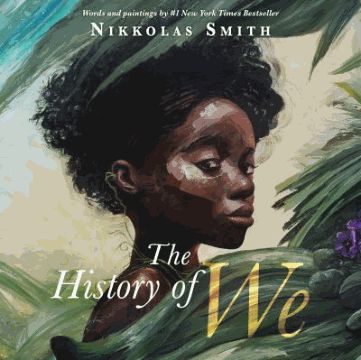 The History of We
Nonfiction / Picture book / Ages 5-8
Penguin Group
May 20, 2025
41

"A ... picture book about the origin and advancement of humans, from author and #1 New York Times bestselling illustrator Nikkolas Smith. Fossil records show that the first humans were born in Africa. Meaning, every person on Earth can trace their ancestry back to that continent. The History of We celebrates our shared ancestors' ingenuity and achievements and imagines what these firsts would have looked and felt like. What was it like for the first person to paint, to make music, to dance, to discover medicine, to travel to unknown lands? It required courage, curiosity, and skill. The History of We takes what we know about modern human civilization and, through magnificent paintings, creates a tale about our shared beginnings in a way that centers Black people in humankind's origin story." Publisher
The Story of We, written and illustrated by Nikkolas Smith, is a book geared for children aged 4-8 that situates the African continent as a site of beginning, in which early humans’ acts are framed with complexity and intentionality. Shelter making is framed as architecture, instruments are framed as the search for and creation of rhythm, and sea travel is framed as boundless curiosity and innovation. This type of narrative shift does important work of dispelling notions that earlier stages of human existence and evolution were lesser. Smith instead makes these milestones central to where and who we are today. Though the book clearly speculates the motivations and emotions of people of the past in ways that cannot be directly supported by the scientific record, it is nonetheless an effective storytelling tool to resituate these agents as part of the human story. The book is a visual feast. Nikkolas Smith’s paintings evoke a freedom of movement and imagined possibilities, while also feeling earthy and textured, reminiscent of both the emerging use of these practices and their intersection with nature. Smith’s illustrations aptly demonstrate milestones of human achievement in its nascent periods in the African continent. The book also includes a comprehensive timeline at the end of the book that provides valuable context about the data at the heart of his narrative, including references to paleoanthropological findings across the African continent, such as the Blombos Cave and Klasies River. Smith directly connects his artwork to ideas of forged kinship and emerging curiosity, using evidence such as artwork, tool and medicine use, near and far maritime exploration, and agriculture. The book’s aim, transparency of evidence, stunning artwork, and compelling narrative worldbuilding are key strengths of Smith’s story.
Where the book’s framing becomes more problematic is in its probing of the “we.” The evoked we leans into unity, but it does so at the expense of acknowledging Africa’s significant diversity. For example, discussions of language are framed in a way that suggests that “we” created a language to communicate, not mentioning the many populations existing across the continent or diversifying language forms. This recurring issue is most clear in its ending quote, “From the Mother Land, into every corner of Mother Earth, one group became many…” Africa is not a homogeneous place in any regard, containing the most genetic and linguistic diversity on the planet, and this statement reads as though significant differentiation of early humans did not occur until Out of Africa migration. The book echoes this imagery in its depiction of the people, representing what “we” did and decontextualizing it from the place and context the practices originated from. Though from a narrative standpoint it is understandable to condense data to avoid overcomplicating the plot, it is important to strike a balance between honoring humanity’s origins without assuming affiliation and connection among these diverse groups. Ironically, the timeline at the end of the book implicitly acknowledges this diversity in the sources of data, citing analyses spanning Mozambique to Tanzania to Morocco.
Another core issue with the narrative is the notion of time, and which milestones matter. The book situates us at the “beginning,” which ignores the millions of years of human evolution that got us to this beginning. It is justifiable to define a scope of discussion (in this case an examination of 223,000 – 5,000 years ago), especially for young children who may be encountering these ideas for the first time. However, to not mention hominin evolution at all ignores the aspects of anatomically modern human behavior that are a continuation of key milestones established by hominins, including but not limited to bipedalism, shelter, and tool use. Precisely because the book included a detailed timeline and rationale at the end is why this reads more egregiously, because it establishes one inception point as being the beginning and largely disregards what comes before. Beyond this, the timeline of human origins that the book lays out appears to conflate the idea of anatomically versus behaviorally modern humans. While ~200,000 years ago is largely uncontested for anatomical modernity, much of the larger leaps occur much later (e.g., the start of the story emphasizes the evolution of language, which didn’t hit significant bounds until closer to 50,000 years ago).
With a critical eye to the aforementioned issues, the book is still nonetheless a beautifully illustrated book that positions imagination and wonder as key elements of the human condition. The book would be best enjoyed by younger children as an exciting introduction to our complex human origins!
Andreana Cunningham, PhD
Boston University
Published in Africa Access Review (March 17, 2026)
Copyright 2026 Africa Access